Getting Started
Your VPN is on. Is your crypto safe now? Not so fast.
You are on hotel Wi-Fi and want to check your crypto account. A VPN can help with network privacy. But its green connection indicator does not tell you whether a website is trustworthy or a wallet request is sensible. Separate those checks to choose the protection you actually need.
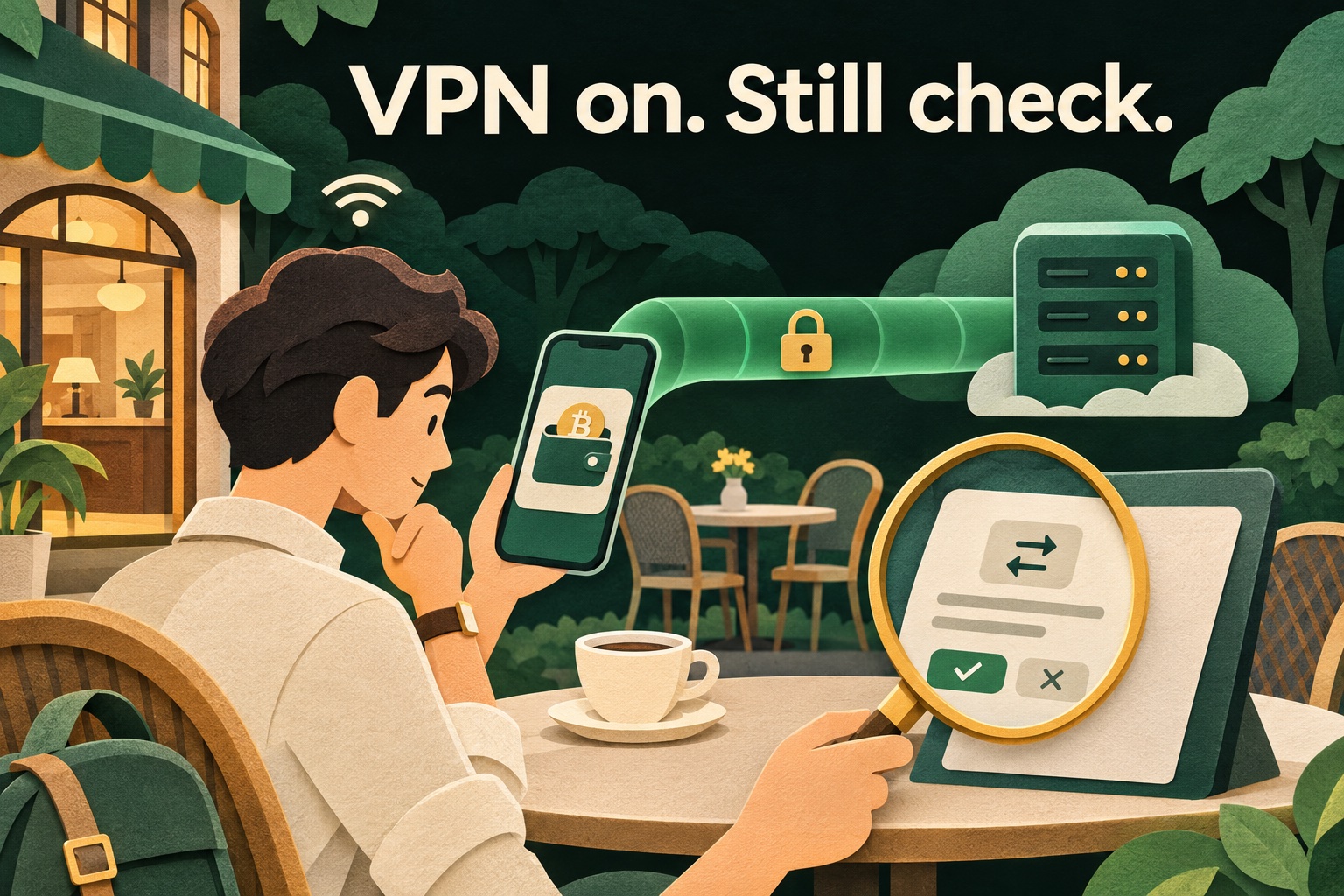
What are you protecting?
A VPN, short for virtual private network, routes traffic through another server. A properly configured encrypted VPN protects the traffic it carries between your device and that server. The local network operator consequently sees less about the destinations you visit. Websites generally see the VPN server’s internet address.
This is network privacy. It says nothing about a crypto platform’s honesty or the contents of a transaction. Think of a closed transport box: watching the contents in transit becomes harder, but the box does not assess the person you hand it to.
HTTPS already does important work
With HTTPS, content between the browser and website is already encrypted. It is therefore wrong to assume that anyone on public Wi-Fi can simply read your password without a VPN. The FTC notes that this protection is now widely used.
A local network may still observe connection information. A VPN can add another layer there. Neither technology proves the website is honest: a fake login page can use HTTPS too. Check the genuine destination, not just a padlock or green symbol on a screen.
A fictional example: Noor travels
Noor wants to check whether a payment arrived while staying in a hotel. She knows her VPN provider and previously installed its app through the official route. She checks that the connection is active and opens her crypto service from a bookmark she saved herself.
Then a “support” message arrives with a link to restore her wallet. Noor does not reason that an active VPN makes the link safe. She closes the message and looks for help inside the official service. These are two different decisions: reducing the hotel network’s visibility and avoiding voluntarily handing information to a scammer.
Suppose the Wi-Fi first requires her to install an unfamiliar security app. Pausing is wiser than automatically following that instruction. Noor can use mobile data for this check or wait for a connection she knows better. A VPN is no reason to disable device protections or ignore a warning.
You are also choosing whom to trust
Using a VPN shifts some trust towards its provider. Look at who operates the service, what it records, which permissions the app requests and how updates are delivered. Check specific claims rather than advertisements using words such as invisible or completely safe.
An independent review can offer useful evidence, but check its date and scope. It is not an everlasting guarantee. Free or paid alone is not proof of quality. Do not hurriedly install a random app because an advertisement says your crypto is otherwise in immediate danger.
What a VPN does not do for you
A VPN alone does not stop phishing, malicious downloads or an unsafe wallet approval. If you type recovery words into a fraudulent website, they still reach that website. Logging into a service can also identify you to that service through your account.
Public blockchain records are not hidden because your connection passes through a VPN. A network address differs from a wallet address. Changing the first does not erase the second’s history. Protect secrets, verify receiving details and review what you sign as separate checks.
Turn it into a small routine
First identify your goal: do you want less visibility for an unfamiliar network, or do you doubt a payment request? Choose the check that answers that problem. Keep your device and browser updated, use strong account protection and verify websites independently. A VPN may fit into that routine, but does not replace it.
You do not need to buy anything to practise. Consider two invented situations: unfamiliar hotel Wi-Fi and a suspicious wallet link. For each, ask what problem a VPN reduces and what remains. Our free quizzes let you continue practising that judgement before a real decision.
Original sources & further reading
- FTC — Public Wi-Fi and HTTPS
- EFF — Choosing a VPN and its limitations
- FTC — VPN provider trust and permissions
- Ethereum — Public blockchain records
Sources checked on .