Getting Started
You are paying with bitcoin. Does the route match the recipient?
The counter says “Bitcoin welcome”. Your wallet offers Bitcoin and Lightning. They use the same currency, but not the same kind of payment request. Understand the distinction before scanning: a familiar name alone does not prove the payment route fits.
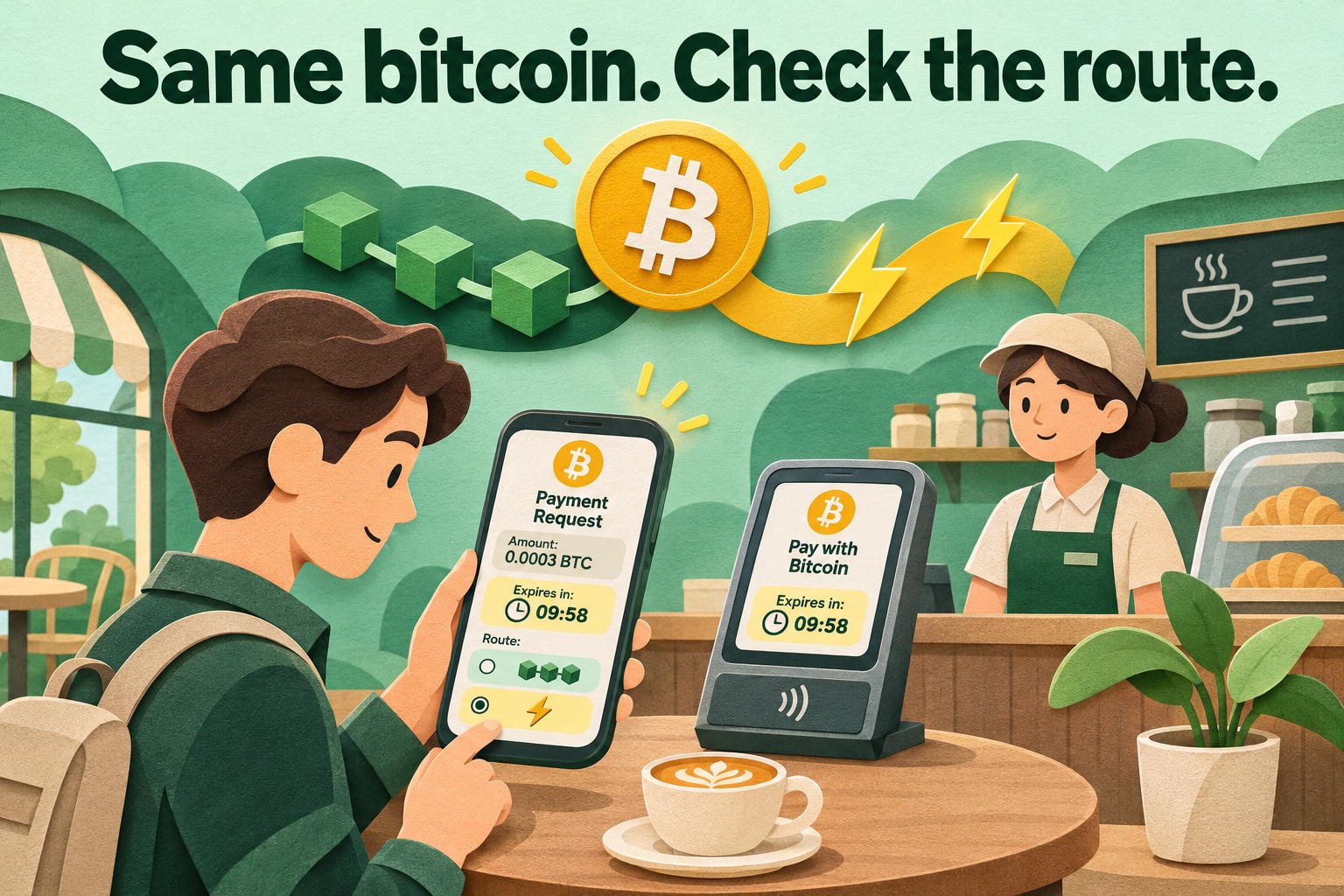
The same bitcoin, a different way to pay
A normal Bitcoin transaction is recorded on the Bitcoin blockchain. Lightning is a payment network built on Bitcoin. Payment channels allow payments without every individual payment immediately becoming its own blockchain transaction. Final settlement still relies on Bitcoin.
You do not need to build that technology to understand the main point: a wallet or platform must support the chosen payment method. Seeing Bitcoin on both sides is insufficient. A normal receiving address and a Lightning payment request cannot simply be used interchangeably.
A payment request still needs checking
For many Lightning payments, the recipient creates an invoice: a digital request for payment. It can include an amount and an expiry time. The wallet reads these details and shows what you are about to pay. This saves typing, but does not perform your checks for you.
Some apps also support other kinds of Lightning addresses or requests. Capabilities differ between services. Coinbase, for example, documents invoice support with its own conditions. Use current receiving instructions and documentation for the apps involved. Do not rely on the appearance of a QR code or an old screenshot.
A fictional example: Sam buys coffee
Sam wants to pay with bitcoin in an imaginary café. The seller presents a Lightning request for the coffee. Sam’s current wallet can only send to an ordinary Bitcoin address at that moment. He does not force the request into an unrelated address field or buy a supposed “Lightning token”.
He asks which other payment route the seller supports. If they find a compatible route, Sam checks the new request, amount, unit and total charges. Otherwise, he chooses another payment method. Stopping is a normal payment decision, not a technical failure he must urgently work around.
A request can expire
An invoice may have limited validity. Its exact duration depends on the request and service; do not turn one provider’s expiry period into a universal rule. An old request saved in your photo gallery is therefore not a reliable permanent payment instruction.
If your wallet reports that the request expired, ask for a fresh one through the same verified contact. Check it again. If you already attempted payment and the outcome is unclear, inspect the payment history first and ask the recipient to check what arrived. A new request could otherwise lead to an unintended second payment.
Speed does not make checks unnecessary
Lightning is designed for fast payments, often with low fees. That is not a guarantee for every wallet, amount or moment. Route availability, limits, fees and the service used can affect the result. Coinbase notes, for example, that certain sends may take longer or fail.
Before confirming, inspect the amount to be deducted and any service charges. Check the unit too: a satoshi, often shortened to sat, is a small part of a bitcoin; 100 million sats make one bitcoin. A large number in sats must not be confused with that same number in euros or bitcoin.
Keep your payment decision simple
First establish the route the recipient expects. Then check that your wallet supports it. Review the current request, amount, unit and charges. Confirm only when they all match. A fast route does not remove the need to trust the recipient and keep recovery information secret.
This is not a recommendation to install a particular wallet or buy bitcoin. You can practise with a fictional request and our free quizzes. The useful skill is recognising when the payment details fit together and when it is better to pause.
Original sources & further reading
- Lightning Network — How it works
- Coinbase — Lightning payment requests
- Lightning BOLT 11 — Invoice amount and expiry
Sources checked on .